

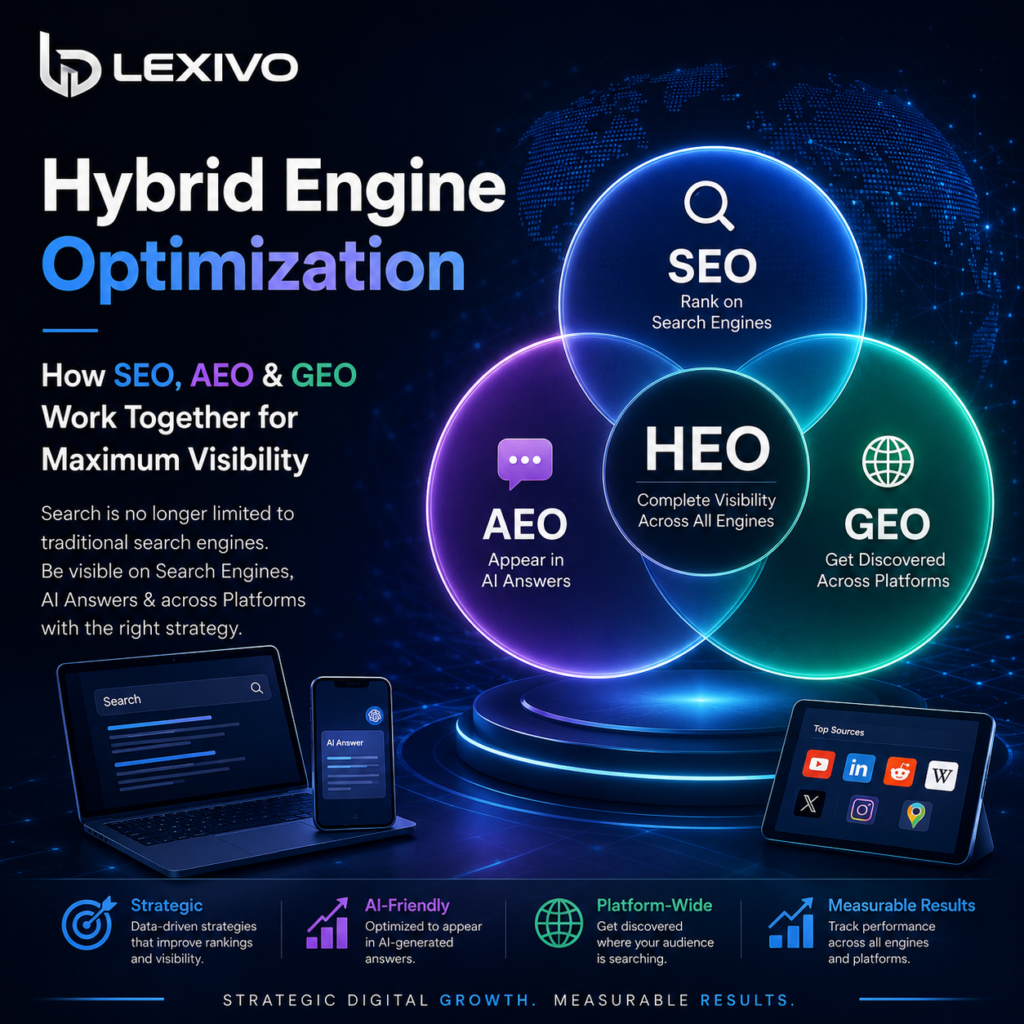
Search is no longer limited to traditional search engines.
Today, people discover brands through Google search results, AI-generated answers, voice assistants, conversational search tools, and intelligent recommendation systems. Because of this shift, businesses now need visibility across both traditional search engines and modern answer-driven platforms.
This is where the concept of Hybrid Engine Optimization (HEO) becomes important.
HEO is the combined strategy of:
- SEO (Search Engine Optimization)
- AEO (Answer Engine Optimization)
- GEO (Generative Engine Optimization)
Together, these approaches help brands stay visible across the full digital search ecosystem.
Instead of optimizing only for Google rankings, HEO focuses on helping businesses appear in:
- Traditional search results
- AI-generated answers
- Conversational search platforms
- Voice search responses
- Featured snippets
- Smart recommendation systems
In simple terms:
HEO combines SEO, AEO, and GEO into one unified visibility strategy.
Traditional SEO helps websites rank.
AEO helps content become the direct answer.
GEO helps brands appear inside AI-generated responses.
HEO brings all of them together so businesses can stay discoverable wherever users search.
As search behavior continues changing, brands that rely only on traditional SEO risk losing visibility in modern search experiences.
At Lexivo Digital, we see HEO as the next evolution of digital growth — a smarter and more complete approach to online visibility.
In this guide, we will explain how SEO, AEO, and GEO work together inside Hybrid Engine Optimization, why it matters for businesses, and how brands can adapt early to stay ahead.
Search behavior has changed more in the last two years than it did in the previous decade.
People are no longer relying only on Google to find information. They are asking questions directly inside ChatGPT, Perplexity, Gemini, Bing Copilot, voice assistants, and AI-powered search experiences. Instead of scrolling through ten blue links, users now expect direct answers, recommendations, summaries, and personalized responses.
This shift has created a major challenge for businesses.
A website may still rank well on Google, but if it does not appear inside AI-generated answers, it can lose visibility, traffic, and trust.
That is where Hybrid Engine Optimization (HEO) comes in.
HEO is the next evolution of digital visibility. It combines traditional SEO with modern answer-engine and AI-search optimization strategies so brands can remain discoverable everywhere people search.
At Lexivo Digital, we believe the future of search is not about choosing between SEO or AI visibility. It is about building a strategy that works across both.
In this guide, we will break down what HEO really means, why it matters, and how businesses can adapt before competitors take the lead.
What Is Hybrid Engine Optimization (HEO)?
Hybrid Engine Optimization (HEO) is a modern digital marketing strategy that helps brands appear across:
- Traditional search engines like Google and Bing
- AI-powered search platforms
- Answer engines and conversational tools
- Voice search systems
- Featured snippets and AI summaries
- Multi-platform search experiences
Instead of focusing only on rankings, HEO focuses on overall digital visibility.
The goal is simple:
Make your brand discoverable wherever people search for answers.
Traditional SEO was built for search engines that ranked websites.
HEO is built for a world where platforms generate answers.
That means your content must not only rank — it must also be:
- Understandable
- Structured clearly
- Trustworthy
- Easy to summarize
- Rich in expertise
- Relevant to user intent
In simple terms, HEO helps search engines and answer platforms confidently use your content as a trusted source.
Why Search Is Changing So Fast
The way people search online is becoming more conversational.
Instead of typing:
“best running shoes Dubai”
Users now ask:
“What are the best running shoes for beginners in Dubai under AED 500?”
Modern search experiences are designed to answer complete questions instantly.
This changes everything about how websites need to create content.
Today’s search platforms analyze:
- Context
- Intent
- Authority
- Content structure
- User experience
- Brand trust
- Topical depth
Simply stuffing pages with keywords no longer works.
Businesses now need content that actually helps people.
The brands winning today are the ones creating:
- Detailed answers
- Expert insights
- Helpful resources
- Clear explanations
- Structured information
- Consistent authority across platforms
HEO brings all of these elements together.
SEO vs AEO vs GEO vs HEO
Many businesses are hearing new terms like AEO and GEO and feeling overwhelmed.
Let’s simplify them.
SEO (Search Engine Optimization)
SEO focuses on improving visibility in traditional search engine results.
The goal is to rank higher on Google and drive organic traffic.
Key focus areas:
- Keywords
- Backlinks
- Technical SEO
- Page speed
- Content optimization
- Search intent
SEO is still extremely important.
But it is no longer enough on its own.
AEO (Answer Engine Optimization)
AEO focuses on helping search platforms provide direct answers.
This includes:
- Featured snippets
- Voice search responses
- FAQ sections
- Quick-answer content
The goal is to structure content clearly so platforms can extract answers easily.
GEO (Generative Engine Optimization)
GEO focuses on visibility inside AI-generated search experiences.
Platforms summarize information from multiple sources and generate responses.
The goal is to make your content reliable, citable, and easy for these systems to understand.
HEO (Hybrid Engine Optimization)
HEO combines all three approaches into one complete strategy.
Instead of optimizing only for rankings or only for AI visibility, HEO ensures your business performs across the entire modern search ecosystem.
That means:
- Ranking on Google
- Appearing in AI-generated summaries
- Showing up in voice searches
- Being referenced in conversational answers
- Building authority across platforms
HEO is not replacing SEO.
It is expanding it.
Why HEO Matters for Businesses
Many businesses still believe traffic only comes from Google search results.
That is changing rapidly.
Users are now discovering products, services, and brands through:
- AI assistants
- Smart search tools
- Chat-based interfaces
- Voice devices
- AI-generated recommendations
If your brand is missing from these environments, you are losing visibility before users even reach traditional search results.
HEO helps businesses stay competitive by adapting to modern search behavior.
Key Benefits of HEO
1. Greater Online Visibility
Your brand becomes discoverable across multiple search experiences instead of relying on one platform.
2. Stronger Brand Authority
When platforms consistently reference your content, your business gains trust and credibility.
3. Better User Experience
HEO prioritizes content that is clear, useful, and genuinely helpful.
4. Future-Proof Digital Strategy
Search technology will continue evolving.
HEO prepares your business for the next generation of search.
5. Higher Quality Traffic
Users who find your brand through detailed answers are often more informed and ready to convert.
The Core Elements of Hybrid Engine Optimization
HEO is not one tactic.
It is a combination of several strategies working together.
1. High-Quality Content
Helpful content remains the foundation of visibility.
But modern content must do more than target keywords.
It should:
- Solve real problems
- Answer direct questions
- Provide practical value
- Be easy to understand
- Include clear structure
- Offer unique insights
Thin content no longer performs well.
Search platforms prioritize pages that demonstrate genuine expertise.
2. Search Intent Optimization
Modern search is driven by intent.
Businesses need to understand:
- What users want
- Why they are searching
- What problem they need solved
- What information they expect
The best-performing content aligns closely with user intent instead of focusing only on keywords.
3. Structured Content Formatting
AI-powered platforms prefer content that is organized clearly.
That means using:
- Headings
- Subheadings
- Bullet points
- FAQs
- Tables
- Short paragraphs
- Clear definitions
Well-structured content is easier to understand, summarize, and reference.
4. Topical Authority
Publishing random blog posts is no longer enough.
Brands need to build deep expertise around specific subjects.
For example, a digital marketing agency should not publish one SEO article and stop there.
It should build complete topic clusters covering:
- SEO
- Local SEO
- Technical SEO
- Content marketing
- AI search visibility
- Link building
- User experience
- Analytics
The deeper your expertise, the stronger your authority becomes.
5. Technical Website Performance
A slow or poorly structured website hurts visibility.
Important technical factors include:
- Fast loading speed
- Mobile responsiveness
- Secure browsing
- Clean site architecture
- Structured data
- Crawlability
- Accessibility
Technical optimization remains a critical part of HEO.
6. Brand Trust Signals
Modern search systems evaluate credibility across the web.
That includes:
- Reviews
- Mentions
- Backlinks
- Social presence
- Industry recognition
- Consistent branding
- Expert authorship
Brands with stronger trust signals often receive greater visibility.
How AI Search Is Changing Content Strategy
For years, businesses created content primarily to rank.
Now, content must also be understandable in conversational environments.
That changes how content should be written.